Cowan wire mesh machine manufacturer provides OEM& ODM service for all kinds of wire mesh machines
Language
Cowan wire mesh machine manufacturer provides OEM& ODM service for all kinds of wire mesh machines
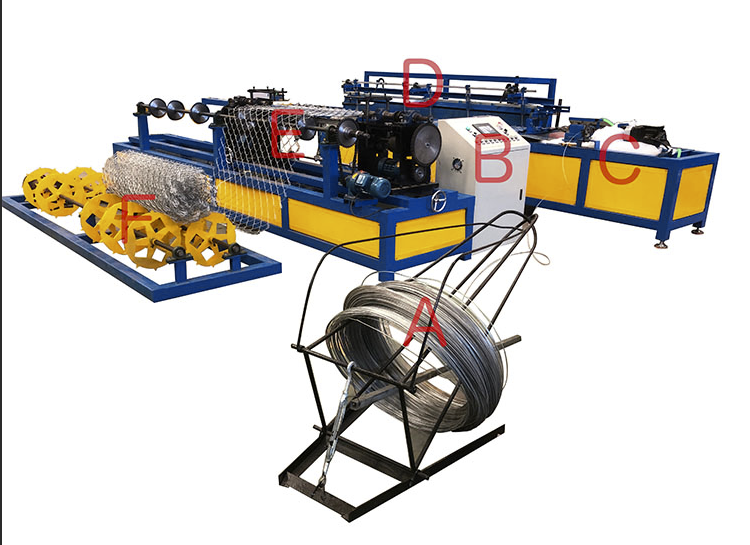
Key built-in modules of single wire chain link fence machine:
Wire pay-off rack
Automatic weaving machine
PLC touch screen control cabinet
Edge processing system
Automatic mesh roller machine
2. Step-by-Step Production Process of Single Wire Chain Link Fence Machine
This section explains exactly how the machine turns raw galvanized/PVC coated wire into finished chain link fence rolls.
Step 1: Raw Wire Loading and Automatic Straightening
First, workers mount galvanized wire, PVC coated wire or stainless steel wire coils on the fixed pay-off rack of the single wire chain link fence machine.
The wire is sent into the straightening wheel group, which removes wire bending and ensures uniform wire feeding speed. The tension control system keeps wire tight during weaving to avoid loose, deformed diamond holes.
Step 2: Spindle Rotation and Wire Twisting Forming
This is the core working step of the single wire chain link fence machine.
The spindle rotates at a stable preset speed, wrapping the single metal wire into a spiral ring. As the spindle advances forward, the new wire ring automatically interlocks with the previous ring, forming neat diamond mesh openings one by one.
All weaving parameters (mesh hole size, wire feeding speed) can be adjusted on the PLC touch screen.
Step 3: Servo Traction for Standard Mesh Size
A servo traction trolley pulls the woven diamond mesh forward at fixed intervals. This step controls the vertical spacing of the diamond mesh, guaranteeing consistent mesh dimensions for every finished roll.
For export orders to Central Asian Stan countries like Uzbekistan and Kazakhstan, uniform mesh size meets local agricultural ranch fence inspection standards.
Step 4: Automatic Fixed-Length Cutting
Users set the target wire length on the PLC program in advance. When the traction sensor detects the mesh reaches the preset length, the cutting cylinder instantly cuts the single wire. The whole cutting process takes less than one second without manual intervention.
Step 5: Automatic Winding into Finished Chain Link Fence Rolls
The completed diamond mesh slides onto the winding roller of the single wire chain link fence machine. The roller automatically winds the flat mesh into tidy compact rolls.
Workers only need to remove the finished mesh roll and label specifications for packaging, storage and export transportation.
Main Applications of Mesh Produced by Single Wire Chain Link Fence Machine
The diamond chain link fence manufactured from single wire weaving machines covers multiple global industries:
Agricultural livestock fencing: Cattle yard, horse paddock, sheep pasture fence for Central Asian ranches
Residential & commercial fence: Villa garden isolation mesh, swimming pool safety barrier
Construction engineering: Temporary site safety fence, warehouse separation mesh
Municipal infrastructure: Highway guard fence, park boundary protective mesh
Security protection: Factory perimeter anti-climb mesh, border isolation fence
FAQ
Q1: What raw wires can a single wire chain link fence machine process?
A: It can weave low-carbon galvanized wire, electro-galvanized wire, PVC plastic coated wire and stainless steel wire, widely used for outdoor anti-corrosion chain link fence.
Q2: How many workers are required to operate a single wire chain link fence machine?
A: Only one worker is enough for daily operation. Workers just need to replace wire coils and collect finished mesh rolls, no complex manual weaving work.
Q3: Can single wire chain link fence machines produce mesh for Kazakhstan and Uzbekistan ranches?
A: Yes. The machine supports custom mesh specifications matching Central Asian livestock fence standards, and the equipment voltage can be adjusted to local 380V industrial power supply.
Q4: What is the difference between single wire and double wire chain link fence machine?
A: Single wire models adopt one wire for weaving, low cost, small footprint, suitable for small-batch production. Double wire machines feed two wires at once with higher output, ideal for large factories with mass export orders.

ANPING COWAN WIRE MESH & MACHINES CO., LTD is a professional company in wire mesh machines and wire mesh fences. All of the machines will run and produce customer asked specification products in our factory before sending to our customers to make sure the machine’s quality.

